
The Role of AI in Modern Contract Management
For many organizations, contract management is one of the most important parts of controlling spend, yet it often receives the least attention. Teams negotiate terms, secure pricing, agree on renewals, and set expectations with vendors, but once the contract is signed, the administrative work begins. This stage is rarely simple. It requires capturing a dense set of details, storing the agreement somewhere accessible, and making sure the right information flows into purchasing and accounts payable.
When everything goes well, this work is tedious but manageable. When it doesn’t, the impact spreads quickly.
This article breaks down why contract data is so difficult to manage, how errors creep into purchasing workflows, and how modern AI-powered contract management software changes what’s possible.
Why contract data is so difficult to manage
A contract carries a dense set of information: dates, renewal terms, pricing structures, payment schedules, obligations, and legal language. Some span only a few pages while others run much longer, and even a small oversight can affect budgeting, purchasing, invoice matching, or compliance.
The challenge isn’t only the volume of information but the lack of standardization. Vendors use their own templates. Dates appear in different formats. Payment terms are worded inconsistently. Someone entering this information must interpret what each field means and translate it into structured data for internal systems.
Traditional tools, such as optical character recognition, can extract text but cannot understand the meaning behind it. They cannot distinguish between a start date and a renewal date, or interpret phrases such as “thirty days from the effective date.” They also cannot reliably match vendor names or terms to existing records. The most important decisions still rest with the person reviewing the document, which is where inconsistencies often begin.
What AI can do for contract management in purchasing
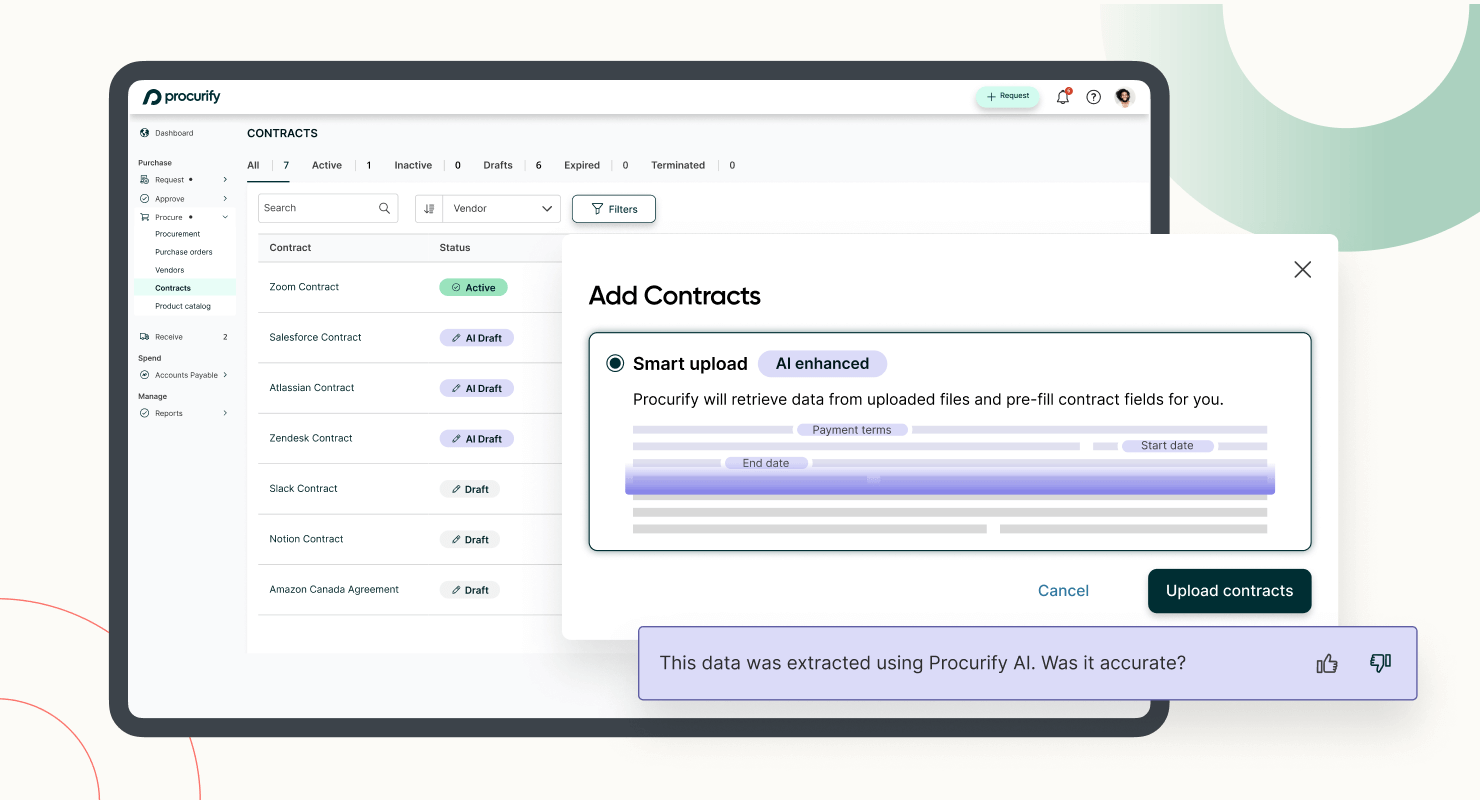
Recent advances in natural language understanding allow AI-powered procurement systems to read contract documents much like a person would. Instead of simply detecting text, the system interprets context. It can identify which dates define the start or end of a term, understand renewal language, and recognize when different vendors use different wording to describe the same obligation. It can also summarize clauses into plain language when needed.
AI connects what it reads to existing vendor records, matching suppliers mentioned in the contract to the correct profiles in the organization’s database. This ensures contract information ties directly to real purchasing activity rather than living in a standalone file.
This is the same underlying intelligence used in AI-intake-for-orders, which interprets vendor quotes and maps them into structured request fields. Whether applied to quotes or contracts, the value is the same: AI turns unstructured documents into usable data that moves cleanly through the purchasing lifecycle.
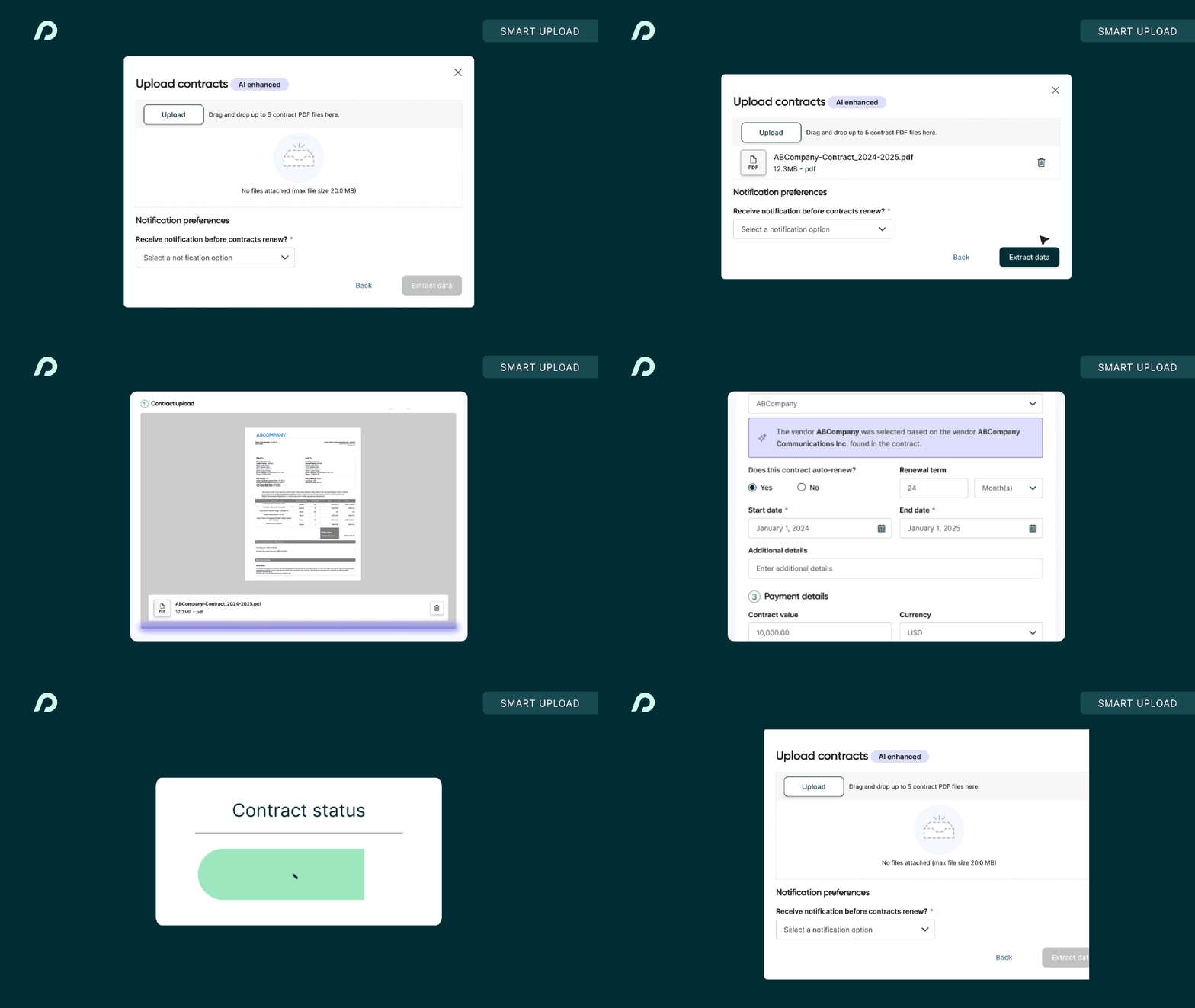
The result is a significant reduction in manual work. Instead of retyping dates, terms, amounts, and vendor details, users receive a draft with the essential information already populated. Review replaces transcription.
For teams managing dozens or hundreds of contracts, the impact compounds quickly. Work that once required several minutes of reading, interpreting, and manual entry can now be completed in a fraction of the time — and with much greater consistency across the organization.
What this means for purchasing spend control
When contract details are captured accurately, purchasing stops operating in the dark. Teams know exactly what was negotiated, what the organization is committed to, and how much value remains on a contract before approving new spend. This creates a cleaner handoff throughout the procure-to-pay process, ensuring requests and purchase orders align with the actual terms rather than relying on memory or scattered documents.
Accurate contracts also anchor spend control. Budgets reflect real commitments rather than rough estimates. Variances are easier to spot because the system knows the contract value, the billing schedule, and whether an invoice falls inside or outside the agreed-upon terms. Approvers gain clearer context, and AP teams spend less time reconciling mismatches.
The biggest change is predictability. Instead of discovering issues at month-end or after a renewal, teams see upcoming obligations earlier and understand how contract-driven spend will impact budgets throughout the year. This creates a stronger foundation for proactive purchasing decisions and tighter financial oversight. This same operational shift is evident more broadly in AI adoption in procurement, where structured data enables better control over commitments.
Next steps for better contract management
Better contract management ultimately comes down to having information that teams can trust. As organizations look for ways to modernize purchasing and improve visibility into spend, the role of contract data becomes clearer: it shapes decisions long before a purchase order is created and long after an invoice arrives. With AI reducing the effort required to capture that information, teams can finally treat contracts as a dependable part of the process rather than a persistent source of uncertainty. That shift doesn’t redefine procurement, but it does make it far easier for organizations to operate with confidence as their needs and spending grow more complex. Understand how contract management can work for you.
$30B+ in real spend data you won’t get anywhere else
Find out what it takes to move from reactive to AI-driven operations.